Friday, July 27, 2012

A Visit to a Heritage Garden in Sisbichen

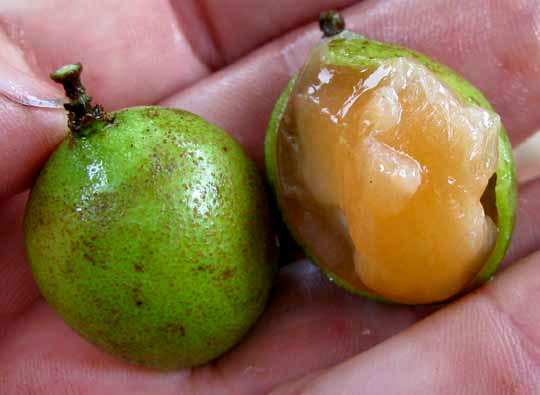
Danny (U Chicago Grad student) ponders the magic of the Saramuyo (sugar apple)
After about thirty minutes of driving on the tollroad from Valladolid to Cancun, we turn down a small dirt road.  We pass Uspibil, then Chechmil, finally arriving in Sisbichen, a town with about 1500 inhabitants, most of whom speak Maya.  Sisbichen is named after the Vanilla planifolia orchid that grows abundantly in the town's jungles, whose pods are used to produce vanilla.  The plant is called Sis bik in the region, which means "the one that moves like a snake in the shade.'  Chen means cenote or well.  
Sis bik growing on a tree
We've come here to meet Don Antonio, a man with great connection to nature and plants.  "Don Oxte?  Is it Don Oxte...Abuelo?" she asks another woman in the group that is gathering.  Several other women walk across the square to see what we're looking for.  They begin to speak to each other in Maya, and Danny and I anxiously exchange smiles with one another, waiting to see what the verdict is.  She tells us that we'll need to go to Rancho Yokdzonot, several kilometers down the main road.  As we pass through the gates, we enter a sort of paradise, home to an unusual mix of plants and animals and a man with a vision for harmony with nature.  


Don Antonio and Cintia
Don Antonio and his wife Cintia direct a non-profit called Jardines del Colibri Dorado (Gardens of the Golden Hummingbird) dedicated to reforestation of fruit and lumber trees, as well as jungle reforestation.  In the town of Sisbichen, they run a teaching project, giving lessons on organic gardening.  Today, Cintia is waiting to hear back from a man who will deliver many gallons of paint, which will be used to paint the local school.
The Entrance to Don Antonio's Ranch
Antonio Oxte is returning from a swim in a cenote when we meet him.  He begins the interview by introducing himself and labeling the small Maya pueblo where he's from on my map.  He's been at the ranch for 7 years, and in this time, has cultivated plants that he brought as plants and seeds from around the world - including the Andes, Greece, Africa, the Amazon, and Canada.  His vision is to have a place where he can grow plants to eat and to cure. "How did you come to travel to so many places?"  I ask.  He chuckles and begins a story that is so far-fetched, you'd need to hear him tell it yourself to believe it. From an early age, Oxte learned of his talents as a healer.  He spent many years walking across the globe, once all the way from Canada to South America, where he stayed for 7 years in the Amazon.

Rare orchids
Papalo
As we walk around the property, their knowledge of plants and their commitment to living off of the land becomes very clear.  It seems that after almost every plant we see, Cintia adds "we eat this almost everyday," and tells us how it is used.  Each plant has a story - where it came from, why it's important, and how brought it to the ranch.  There's a pine seedling from Canada that's struggling in the Yucatan heat.  Don Antonio is sure it will live: "It's already taken to the soil.  A little stressed out from when I moved it, but doing really well now" he reassures.  A bean plant from Peru is thriving, spreading out over a trellis and a nearby tree.  The seed it grew from was hundreds of years old, dormant when found in a cave.  In about a month, the plant will be filled with half-dollar sized beans, half-white and half-black.  There's cucumber growing on a tree, and an orchid yet to be classified, and a healthy bush-like papalo, which Don Oxte uses to treat anemia.  Cilantrillo, a plant with delicate flowers, he tells us is the most powerful antibiotic.  La hierba del zorillo (skunk) (in Yucatec Maya: Payche) can be inhaled or rubbed on the skin to treat bronchitis and muscle aches.
Cilantrillo's small white flowers
Evidence of an earlier ceremony
Walking around the property, we come to a huge cenote, with birds flying in and out of its cave-like walls.  A blue butterfly flutters by.  The cenote is virgin, used only for bathing and drinking water.  Candles from a ceremony the night before form a shape along its edge.  It's a perfectly balanced ecosystem.

One of don Oxte's virgin cenotes
With doña Cintia on the Sac-be
Walking back towards the house, we begin to meet many of the beautiful chickens and ducks that call the ranch home, as well as a deer who was raised from a baby after her mother was killed, and several pets who are half coyote/half dogs, whose coyote-ness becomes evident when they begin to howl at a visitor.  The road we're walking down is a Sac-be, one of many sacred Maya roads which remain perfect preserved after thousands of years.  In many ways, the scene is surreal.
Patricia
The coyote dogs
For the moment, Don Oxte is looking to partner with an organization or university to create a survey of the Flora and Fauna on his property of more than 100 hectares.  "There are so many unidentified species here.  I'd really like to know exactly what I have"  he says.  I'm in agreement.  From green bees to rare orchids, a day on the Ranch leaves me wondering if I've imagined some of things I've seen.

Looking up at a pich tree in amazement


Thursday, July 26, 2012

The Yucatán Peninsula: Land of many cenotes

What are you supposed to do when it’s too hot to walk around town, and even sitting in the shade doesn’t provide much relief from the heat? Most inhabitants of the Yucatán would tell you to take a dip in a nearby cenote. Cenotes are natural pools of fresh water that form when the bedrock of limestone collapses and the groundwater underneath becomes exposed. 

Cenote Zaci from a nearby restaurant
The water is usually cool and clear, and diameter and depth can be pretty varied. Because geologists have been interested in these formations for some time now, there is a basic categorization of four types of cenotes, depending on how exposed the water is and the general shape of the surrounding walls and depth of the water. 


Some stalactites hanging from the cenote's ceiling
So far we have visited three: Cenote Ik Kil is near the Mayan ruins of Chichen-Itza; Cenote Zaci is within the city of Valladolid; and Cenote Dzitnup is about five minutes away from Valladolid. Cenotes can also be found in a few other parts of Central America, the southwestern US, and even Australia and Canada, although they may be called sinkholes or something slightly different.       

In the Yucatán Peninsula, there are many cenotes, and some have been made more human-friendly than others, with the additions of artificial lights, ropes which cross through the water and connect one edge to another, stair railings, steps going in and out of the pool, and places from which people can jump.
View from the surface
Here's one way to take a break from treading water!


Humans aren’t the only beings swimming in cenotes though. If you look down into the cenote, you will likely see a bunch of black catfish, between one and seven inches long, near the surface. These and other fish are not harmful – they swim around people enjoying the fresh water and get out of the way when you enter their territory. 

Catfish friends
One of the bigger catfish in the cenote - check out his mustache!
Other critters include lizards like iguanas, geckos, and anoles; frogs; turtles; and bats and swallows flying near the ceiling of the cenote. According to some people we spoke with, the swallows are not native to Mexico, but rather they come to take advantage of the food and weather so they can reproduce, make nests, and raise their chicks.


Some of the pink lights at the underground Centote Dzitnup
All of the cenotes we have seen so far have a lot of plant life all around them. In some cases, there are vines hanging from a higher part of the cenote which almost reach the water’s surface. Despite all the amazing plant and animal biodiversity in the environment in and around cenotes, I never felt threatened. 
Visitors to Cenote Ik Kil, a popular cenote in the region
The most dangerous part of cenotes really stems from a person’s swimming ability–signs saying that visitors should swim at their own risk are common. If you feel compelled to jump (it’s really fun), it’s very important to jump away from the edges of the cenote, where there can be sharp rocks near the surface of the water. 

One of don Antonio's virgin cenotes     


Visiting the Yucatán would not be complete without visiting at least one cenote. Admission is usually fairly cheap (the cheapest was 15 pesos, and the most expensive was 70 pesos), and apart from being refreshing, the cenotes provide a good way to exercise. Treading water, swimming, and balancing on the ropes that lie in the water were just a few of the ways we entertained ourselves.

If you’re astute enough to notice that the style of this entry is slightly different from those that have come before, there’s a good reason for that! I’m Danny, a friend of Jenny’s and a graduate student in the same program (the University of Chicago’s Urban Teacher Education Program) she graduated from last year. After I observed and interviewed her for a teacher study project, she asked me to come along with her for part of her trip to Mexico to help with some documentation and other tasks.


As fun as cenotes are, the floor around the pool can be really slippery! (or slepering, depending on who you ask)


Tuesday, July 24, 2012

Adios Izamal and Hotel Macanche!

My Room at Macanche

Xoria and Raj, visiting from India!
Jungle Paradise


After a great stay in Izamal, I said goodbye to the beautiful gardens and people of Hotel Macanche.  It's been a pleasure to spend the last week in here at Macanche.  On a trip to to study the flora and fauna of Mexico, I can't imagine a better place to wake up each morning than the gardens of this hotel. They are home to countless species of plants and animals, forming an oasis in the Pueblo Magico of Izamal.  Each night, I feel asleep to the singing of geckos and bullfrogs all around me (sometimes in my shower ;)... and each morning, woke up to the birds.
Taxis of Izamal, in front of the Convent
Henequin, an Agave, used to produce ropes, bags, jewelry, and liquor
Macanche's owner, Alfred, has been particularly helpful in connecting me with people and places related to my conservation and plants.  Izamal has a wealth of resources, many of which I will need to save for another trip.

On my last day in Izamal, I traveled with a group from the hotel to Dzilam de Bravo, a coastal town about an hour to the north.  We spend the day in Sayachuleb, a cooperative of Maya fishermen and naturalists who are dedicated to preserving the area through sustainable eco-tourism.  Sayachuleb is a maya word which means "Pajaro de Aguado" or water bird.  We took a boat from the Gulf to the River Angosto which is a series of mangroves of four varieties:  red, white, buttonbush, and thatch palms (chit).  There are also several important epiphytes, including three varieties of orchids.

Lovely Flamingos of the Yucatan
The reserve is home to more than 400 species of animals, including the endangered margay (tigrillo), parrots, and tayra.  On this trip, we came to see the flamingos, which migrate to the mouth of the river, where they spend many hours peacefully feeding on brine shrimp and blue-green algae.  The carotene in the flamingo diet gives them their brilliant pink color, which is stunning against the backdrop of the green low-land jungle.
Tayra - in the Weasel family


Margay
Spending the day in Sayachuleb was peaceful and refreshing.  The cool cenote waters made for a perfect swimming hole at the end of the day.

Next stop:  Valladolid...Time to explore the cenotes of the region, models of perfect ecosystems and visit a mystic who cures with plants and has an international heritage garden.


Sunday, July 22, 2012

Delicious Times in Izamal: Cooking Classes at Macanche!

Elsy shows us how to prepare the filling
Today, I learned how to make one of my favorite Mexican dishes:  Chiles Relleños.  My first night at Macanche, I tried their delicious version for dinner and knew I just had to have the secret.  Best of all, this recipe can be made with ingredients right out of a heritage garden - peppers (poblano, green, yellow, and red), onions, herbs like epazote and cilantro, and garlic.

I took the lesson with a couple visiting from Holland and our head cook, Elsy, who had been cooking all of her life.  We began with an appetizer, Crema de Poblano, a delicious and rich soup made from half cream and roasted poblano peppers, as well as a few secret incredients which give it an international flair.

Now, onto the Chiles Relleños.  Alfred, Macanche´s owner, told us we were getting one of his best recipes, but also said the dish is like Jazz, many improvizations depending on the region and the chef.  While I´m looking forward to returning home and trying out my own varieties, I wouldn´t mind if this were the only recipe I ever had because   it´s just that delicious!


The process starts with blackening the peppers over a gas flame, to remove the outer skin.  The secret of these chiles is definitely the sauce, as well as perhaps the breading technique.


We were a little slow in the kitchen... our delicious meal was ready, complete with black beans and rice, in about 1.5 hours.  The time was worth it, as we sat down to enjoy a gourmet Mexican feast!
Delicious Creme of Poblano Soup

Time to Eat!


Saturday, July 21, 2012

Nature Adventures with a Herpetologist!

This morning at breakfast I met Cindy Wilber, director of Proyecto Itzaes, a non-profit in the Yucatan that is empowering communities through literacy and other sustainable educational opportunities.  Wow!  Check them out  at http://proyectoitzaesusa.org.  Cindy, along with her son Simon, were heading out to a property in nearby Cenotillo to conduct a reptile survey with Hillary, a herpetologist from UC-Davis.  Sounds like a great day for a biology teacher to tag along!

A fine capture!
I haven't spent a lot of time capturing reptiles in the past twenty years, though I did have a lot of experience with the sort in my early days, having older brothers who were boys scouts and growing up in wooded areas.  Little did I know that in no time, I'd be back to my old self!
Nice lines!


Herpetologists have special tools that they use to handle reptiles..sort of a modified fishing pole with a slip-noose on the end. And they also just get really excited and use their hands, which apparently requires gently grabbing the leg of the lizard or frog, as to not damage its organs.  For the day, I was more of a spotter, keeping my eyes open and calling when I'd found something.

Hillary and Simon document their findings
The first find of the day was waiting for us when we arrived to the property, a large rattlesnake found by the property's workers, Mike and Ariel, who were waiting proudly when we arrived.

Out on the prowl...
Setting up the camera


We spent a considerable amount of time tracking down whiptails and anoles, who were easier to spot than to lasso.  Next, we took a trek into the low-land jungle to set up a motion-sensor camera in front of a fruit tree.  If all goes well, the camera will capture pictures of animals feeding on the fallen nance, giving a better idea of the biodiversity of the area.  There are definitely many armadillo in the area, whose round bodies leave tunnels in the long grasses.

The afternoon rainstorm brought a fresh catch of frogs, several with beautiful colors.  For now, the mission is just creating a list of reptiles and amphibians living in the area.  From there, perhaps more studies will follow.  After a few days of work, the list stands at about fourteen, with many, many more to be discovered.  More adventures await for those willing to discover the secrets of the forest.  Speaking of which, this is a playground for little gnomes who play in the forest nearby, which the Maya call aluxes.  Not my first encounter with los duendes, but definitely cool to see them alive and well in this area. ;)
Kahtal Alux

Friday, July 20, 2012

A Visit with Aureliano: Preserving Nature and Maya Culture

The entry to Pool´s workshop reads: Take care of Ecology, It´s part of your Life
Face of the Cultural Preservation Campaign
Past the train tracks, on the border of Izamal's downtown, a thatched roof and bamboo walls (in the style of a traditional Maya hut) are the entry to the Workshop of Aureliano Pool, an advocate for preservation and an artesian.  If Aureliano looks familiar, you may have seen him, as he was the face of the  ¡WEY YANO’ ONE’! posters, part of Yucatan's Cultural and Indigenous Language Preservation Campaign.

Aureliano has welcomed visitors from around the world, including China and Hungary.  He's hosted reporters from National Geographic.  And today, Aureliano is sitting in his kitchen having lunch when I enter his patio, which display various arts and crafts depicting Maya traditions and animals of the region. Sr. Pool has transformed his backyard into a lush jungle trail.  Along the trail, he has placed dozens of sculptures - heads, animals, wash basins.  Aureliano is careful to point out which ones are original and which are reproductions, as well as the story behind each one.

                                     We pass the Apiario Maya, a model of a Maya beehive constructed out of a hollowed-out log.  The bees enter a small hole in the front of the log.  After about 3 months, Aureliano tells me, the log will be filled with honey, which can be accessed by opening the end of the log and sliding out the trays inside.  "Xunan cab"  he says, asking me to repeat, until I've said it perfectly.  This means pretty woman honey, as the bee Abeja Mellipona Bechar, looks like it has beautiful eyes, and does not sting... a beekeeper's dream!


Further down the trail, we pass a Maya altar of stone heads and a Piñuela (maya: Chü), a large bromelid growing in the trunk of a tree.  We head inside to view the artwork of Aureliano´s nephew, Jose, an art professor and visual artist, whose animal prints utilize a technique called xilography.


Altar of Skulls
After the tour, we take a seat on small benches in the workshop to chat.  He interchanges spanish with maya, and then waits, while I practice the word, and perfect it, which usually doesn´t happen.  B’a’alche’means animal.    Wey Yano´ One, signifies ¨We are Here.¨ Aureliano shows me pictures of his family, his Maya artifacts, and pictures of him and his wife at their craft booth near Izamal´s main convent.  In  several photos, he´s in a protest against GMO seeds, which he has seen destroying the diversity of plant varieties in the region.  In this space, culture is defined by language, plants, and art, and it´s clear that Aureliano´s mission is conservation of all three.  As a souvenir for my classroom, I chose a toy lizard from a nature display in the living room.  Dios bo´tik Aureliano!

Ecotourist Paradise: Ox Watz

J. Sarna:  Extreme Pyramid Climber?
From Yucatan Today: "At the moment, Ox Watz is for athletic people who want extreme sports. The tours run from 6 – 8 hours, so that makes for a long day."  After reading a bit about a dot on the map, only several miles outside of Izamal, I ask Macanche's owner Alfred what he knows about Ox Watz.  He tells me it's rustic, a real adventure, and would be a great place to experience the jungle and learn about plants.  I'm sold.  Miguel, from Macanche, makes a call to the Ox-Watz office and I'm told the tour guides will be ready when I arrive to Tekal de Venegas, a town that is about a 10 minute cab ride from Izamal.


I pick up some water, peanuts, and gummy bears at a local store and am on my way to the office in Tekal.  I'm met by Manuel Chan, a Maya and director of the Reserve's tour company, along with Ismael, a Maya who grew up in Tekal and Jorge, a biologist from Mexico City who moved to the area a couple of years ago.  


After talking a bit with the Manuel and the guides about the type of tour I'm interested in and my reasons for coming to Mexico, Manuel gives me the Company's Binder along with a copy of UNAM's Atlas of Traditional Mexican Plants, both of which he stresses are very important books but he wants me to have on the journey to learn from.  After signing a waiver and the guestbook (lasted entry more than a month prior), Manuel tells me that Ox Watz means "three turns or trips" in Maya, meaning I will need to return to Ox Watz two more times in my life.  With that promise, I hop into a truck with Ismael and Jorge and begin the journey to the Nature Reserve.


For the next hour, we drive on a small path through the monte (jungle), passing a few people on bicycles or scooters, along with several state police, who spend a few minutes asking us questions, and then send us on our way.  The grass in the center of the path is as high as the truck, and several times Ismael stops while Jorge uses a machete to make the road wider.  At one point, he jokes that he will need to give Jorge some lessons for cutting back trees.  The key is fewer intentional cuts, that make the most sense.  While driving, we discuss Maya traditions, other groups from the United States that have come to visit, politics (both Mexican and U.S.), and the future of Ox-Watz.  There is a struggle between the desire to expand tourism efforts and the need to conserve the land and the species that live there.  Improving the road means destruction of plants and animals.  So, for now, visits to Ox-Watz are reserved for small groups, who are willing to spend the day hiking and driving long distances.  


In the reserve, we begin with an Eco-Archaeology hike, which takes us to the top of a "conserved" (read: un-excavated, covered in dense vegetation) Pyramid.  The path is steep, and the actual climbing of the pyramid is equally daunting.  Ismael shows me a prism shaped rock to used build the pyramids and describes the great mathematical intellect required to build such a structure.  That seems to be a repeated theme throughout the day: how much the Maya knew - about  math, nature, plants, and living.  On the way down the pyramid, a rock beneath me gives way and I fall, cutting my wrist.  Walking away from the site, Ismael tells me to take out my bottle of water.  "To wash my wrist?" I ask. "No, to close the energy circle.  You've entered here and everything you touch has changed.  It's just something we do to show respect." So, as instructed, I take a sip of water and then pour a sip on the ground, and then some on my bleeding wrist.  


At the top of the Pyramid,
several taller pyramids can be seen in the distance


Guaya Fruit:  Peeling them is the easiest part


Hiking Back from the Pyramid


After hiking back to the truck, we stop to eat some guaya fruit (a stone fruit which involves more sucking on the fruit then actual eating, as the fruit is so firmly held to the stone).  Ismael is seated in front of a calabash tree, whose large green fruit looks like a big head, which according to Popol Vu legend, is exactly that, the head of the sacrificed father of the Hero Twins.  (Good story.. check it out).  


After a short break, it was time for another hike, this time to swim in a Cenote, where I would observe the incredible biodiversity of birds, plants, and insects living within Oxwatz. The cenote is guarded on one side by caves and filicidal trees, who swing their roots and vines across the cenote, suffocating nearby trees of the same species.  The water of the cenote is cool, extremely refreshing after a long day of hiking and driving.  Small fish nibble at my legs as I hang onto the edge, not wanting to venture out into the deep, bottomless swimming well.
On the way out of the reserve, a huge thunderstorm struck, adding to the adventure of the day.  I think we made it out just in time!  I went with Ismael and Jorge to the house of Ismael, where we ate Panuchos (Yucatec snack made with chicken, red onion, and lettuce) and drank Pozol, a drink made of corn chunks, coconut, water, ice and sugar.  Ismael's father comes from a long line of hunters.  He shared stories from hunting in the monte, like the day they netted 10 deer.  A usual catch includes 1 deer and an assortment of small animals like squirrel, armadillo, rabbits, iguana, and such.  It would be past 9pm when I arrived back from my Super Tour!


Oxwatz is not for everybody.  Cenotes and Pyramids can stretch across the Yucatan, in all shapes and sizes.  But for those looking for authentic adventure in the deep jungle, the experience is unforgetable.  The dedication of the Oxwatz community to its vision and mission is truly noted, the connection between Maya culture and nature leaves a lasting impression on the tourist.  Check out their site here, and set up a tour for next time you're visiting the Yucatan!
Looking Down at the Cenote of Ox-Watz